Clean UX vs Cluttered UX: Elevating Digital Experiences That Scale




Every unanswered phone call at a medical practice is a patient who may never call back. Front desks are stretched thin: checking in patients, processing paperwork, handling insurance questions — all while the phone rings. In 2026, a growing number of clinics, dental offices, and specialty practices are solving this with a Medical AI Receptionist: an always-on AI agent that answers instantly, schedules accurately, and never calls in sick. At AI Agents That Run Your Business, we build exactly that — AI agents that answer calls, book appointments, and update your systems automatically — 24/7. This guide explains what a medical AI receptionist is, what it costs, the ROI you can expect, and how to choose the right solution for your practice.
A Medical AI Receptionist is an AI-powered virtual agent that answers patient phone calls around the clock, schedules and reschedules appointments, answers routine questions, verifies patient information, and updates practice systems automatically — handling front-desk phone work 24/7 without hold times, voicemail, or staffing gaps.
Unlike a traditional answering service that simply takes messages, a medical AI receptionist actually completes tasks. It converses naturally with patients using speech recognition and large language models, checks real-time calendar availability, books the appointment directly into the schedule, sends confirmations, and logs the interaction. When a call requires human judgment — a clinical question, an emergency, an upset patient — it escalates immediately to the appropriate staff member with full context.
The technology has matured dramatically. Early phone bots frustrated patients with rigid menus ("Press 1 for appointments"). Today's conversational AI understands natural speech, handles interruptions, switches topics mid-call, and speaks multiple languages. Patients increasingly can't tell — and increasingly don't care — whether the voice on the line is human, as long as the call is answered instantly and the problem gets solved.
For medical practices specifically, the stakes are higher than in most industries. Calls involve protected health information, urgent symptoms, insurance complexities, and anxious patients. A properly configured medical AI receptionist is built around these realities: HIPAA-conscious data handling, strict escalation rules for clinical or emergency language, and tight integration with the scheduling and practice management systems the office already uses.
Practices are adopting AI receptionists because missed calls directly cost revenue, staffing shortages are chronic, and patients now expect instant, 24/7 access — three pressures a traditional front desk cannot solve alone.
The math on missed calls is brutal. Industry studies consistently find that medical offices miss 20–35% of inbound calls during business hours, and nearly 100% of after-hours calls go to voicemail. Research from call-tracking analytics firms shows that roughly 85% of callers who reach voicemail do not leave a message, and a majority never call back — they simply book with the next provider on their search results. When a new patient's lifetime value ranges from $1,000 in primary care to $10,000+ in dental or specialty care, each missed call is a meaningful revenue leak.
"Healthcare call centers and front desks miss up to 30% of inbound patient calls, and 62% of calls to medical practices go unanswered during peak hours." — Accenture Health & industry call-analytics research, 2025
Staffing is the second driver. The healthcare sector continues to face administrative staffing shortages, with front-desk turnover rates of 30–40% annually in many markets. Recruiting, training, and retaining receptionists costs practices thousands per hire, and every departure creates coverage gaps. As we say at AI Agents That Run Your Business, DigitalStaff is built for teams that can’t afford gaps — and no environment illustrates that better than a medical front desk, where a single sick day means dozens of calls hit voicemail.
Finally, patient expectations have shifted. Consumers accustomed to booking flights and dinner reservations in seconds now expect the same from healthcare. Surveys show that a majority of patients under 45 will choose a provider partly based on how easy it is to book, and a large share prefer scheduling outside business hours — evenings and weekends, exactly when human receptionists are gone. A Medical AI Receptionist converts that after-hours demand into booked appointments instead of lost opportunities.
A medical AI receptionist answers calls instantly, books and manages appointments, answers routine questions, collects intake information, sends reminders, and syncs everything to your practice systems — while routing urgent or complex calls to humans in real time.
Here are the core workflows a modern medical AI receptionist handles end to end:
The last point is what separates a true AI agent from a basic chatbot or answering service. Message-taking services create work: someone still has to call the patient back, book the slot, and type the notes. An AI agent completes the work. That is the core of our approach at AI Agents That Run Your Business: AI agents that answer calls, book appointments, and update your systems automatically — 24/7. The phone call ends with the appointment on the calendar and the record updated, not with a sticky note on a desk.
Equally important is what a medical AI receptionist should not do. It should never provide medical advice, diagnose symptoms, or make triage decisions beyond routing. Well-designed systems are configured with hard guardrails: any mention of chest pain, difficulty breathing, or other emergency indicators triggers an immediate instruction to call 911 or a live transfer to clinical staff. The AI handles the administrative 80% of call volume so humans can focus entirely on the 20% that genuinely requires them.
The healthcare AI virtual assistant market is valued at approximately $2.4 billion in 2026 and is one of the fastest-growing segments of healthcare automation, driven by staffing shortages, patient access demands, and rapid improvements in conversational AI quality.
The broader context is even larger. The global AI-in-healthcare market is estimated at over $45 billion in 2026, with administrative automation — scheduling, intake, billing support, and patient communication — representing one of the highest-adoption categories because it delivers ROI without touching clinical decision-making or requiring regulatory approval pathways. Within that, intelligent virtual assistants and AI receptionists for healthcare are projected to grow at a compound annual growth rate of 24–30% through 2030.
"Administrative costs account for roughly 25% of total U.S. healthcare spending — over $1 trillion annually — and automation of scheduling and patient communication is among the most immediately addressable segments." — Health Affairs / CAQH industry analyses
Adoption is spreading beyond early-adopter tech-forward clinics. Dental practices, dermatology, physical therapy, veterinary medicine, optometry, med spas, and multi-location primary care groups are now mainstream adopters. Surveys in 2025–2026 indicate that 35–45% of medical and dental practices have implemented or are actively evaluating AI-based phone automation, up from under 10% just three years earlier. The competitive dynamic is self-reinforcing: once the practice across town answers every call instantly at 9 p.m. on a Saturday, patients notice who doesn't.
Vendor landscape-wise, the market spans generic AI answering tools, healthcare-specific point solutions, and full AI-agent platforms that go beyond the phone to run multi-step business workflows. The distinction matters: generic tools answer calls; agent platforms — like those built by AI Agents That Run Your Business — connect the conversation to your actual systems, so booking, records, and follow-ups happen automatically rather than generating a to-do list for your staff.

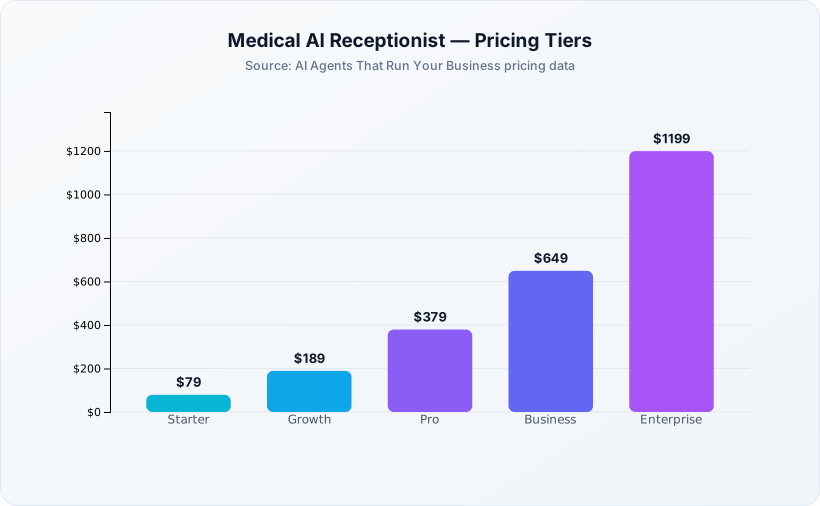
A Medical AI Receptionist typically costs $99–$800 per month depending on call volume and integrations — versus $3,000–$4,200 per month for a full-time human receptionist — and practices commonly report 150–300% ROI within the first year from recovered missed calls and reduced no-shows alone.
Start with the cost of the status quo. A full-time front-desk employee costs $36,000–$50,000 annually once wages, payroll taxes, benefits, and training are included — roughly $3,000–$4,200 per month for coverage limited to business hours. Traditional human answering services charge $1–$1.75 per minute, which for a busy practice easily reaches $500–$2,000 per month for message-taking only. Meanwhile, the revenue leak continues: if a practice misses just 5 calls per day and only 20% of those were bookable new patients worth an average of $200 per visit (far more in dental and specialty), that's $200/day — over $4,000 per month in lost revenue, before accounting for lifetime patient value.
| Service Option | Monthly Cost | Annual Cost | Key Features | Best For |
|---|---|---|---|---|
| Full-time human receptionist | $3,000–$4,200 | $36,000–$50,000 | In-person presence, judgment, empathy; business hours only; sick days and turnover | In-office patient experience and check-in |
| Traditional answering service | $500–$2,000 | $6,000–$24,000 | Message-taking only; per-minute billing; no booking or system updates | Basic after-hours message capture |
| Basic AI phone answering | $99–$300 | $1,200–$3,600 | 24/7 answering, FAQs, simple booking links; limited integrations | Solo practices with low call volume |
| Full AI agent platform | $300–$800 | $3,600–$9,600 | 24/7 calls, real scheduling, intake, reminders, automatic system updates, escalation | Growing practices that can't afford gaps |
| Enterprise / multi-location AI | $1,000–$3,000+ | $12,000–$36,000+ | Multi-location routing, custom workflows, analytics, dedicated support, SLAs | Groups, DSOs, and multi-site clinics |
ROI in concrete numbers. Consider a mid-sized practice paying $500/month ($6,000/year) for a full AI agent platform. If the AI recovers just 3 additional booked appointments per week at an average visit value of $180, that's roughly $28,000 in annual recovered revenue — a 360%+ return before counting reduced no-shows (automated reminders typically cut no-shows by 25–40%), saved staff hours (front desks report reclaiming 15–25 hours per week from phone duty), and after-hours bookings that previously went to competitors. Even conservative models — assuming only one recovered new patient per week — clear 150% ROI comfortably. This is why practices across the industry consistently report first-year returns in the 150–300% range, with dental and specialty practices often exceeding it due to higher per-patient value.
DIY vs. outsourced vs. premium. Some practices attempt DIY builds using off-the-shelf voice AI tools and no-code automation. Realistic DIY costs run $200–$500/month in software plus 40–100+ hours of setup and ongoing maintenance — and errors in a medical context (a missed escalation, a mishandled booking) carry real cost. Basic outsourced AI answering is cheap but often stops at message-taking with a robotic experience. The premium managed approach — a purpose-built AI agent integrated with your systems, with escalation rules and continuous tuning — costs more per month but delivers the actual outcome: answered calls that end in booked appointments and updated records. For most practices, the total-cost-of-ownership math strongly favors the managed AI agent over both the DIY route and an additional human hire.
The market-level financial picture. With U.S. healthcare administrative waste estimated at $250–$500 billion annually and the no-show problem alone costing the industry an estimated $150 billion per year, phone and scheduling automation is one of the highest-leverage cost centers to attack. The healthcare AI virtual assistant market, valued at approximately $2.4 billion in 2026, is expanding precisely because the ROI equation is simple, measurable, and fast — most practices see payback within the first 60–90 days of deployment.
An AI receptionist wins on availability, speed, cost, and consistency; a human receptionist wins on in-person presence and complex judgment; the strongest practices combine both — AI handling phone volume 24/7 while humans deliver in-office care.
| Factor | Medical AI Receptionist | Human Receptionist | Answering Service |
|---|---|---|---|
| Availability | 24/7/365 | Business hours only | 24/7 (messages only) |
| Simultaneous calls | Unlimited | One at a time | Depends on staffing |
| Books directly into calendar | Yes, automatically | Yes, manually | Rarely |
| Updates practice systems | Automatic | Manual entry | No |
| Monthly cost | $99–$800 | $3,000–$4,200 | $500–$2,000 |
| Consistency | Identical every call | Varies with workload/mood | Varies by operator |
| Complex judgment & empathy | Escalates to humans | Strong | Limited |
The framing that resonates with most practice owners is not "AI replaces the front desk" but "AI removes the phone from the front desk's shoulders." Front-desk staff routinely rank phone interruptions as their top stressor — every call pulls attention from the patient standing right in front of them. When the AI absorbs routine call volume, in-office staff deliver noticeably better face-to-face experiences, burnout drops, and turnover slows. The receptionist role gets better, not eliminated.
Answering services occupy a shrinking middle ground. They provide after-hours coverage but create downstream work: every message must be returned, booked, and logged by staff the next morning — by which time a meaningful percentage of prospective patients have already booked elsewhere. Speed-to-response research across service industries consistently shows conversion rates collapse when follow-up takes hours instead of seconds. An AI receptionist eliminates the gap entirely by completing the booking in the original call.

Deploying a medical AI receptionist takes most practices 1–3 weeks: document your call workflows and FAQs, connect scheduling systems, configure escalation rules, test with staff, then go live incrementally — starting with after-hours and overflow calls.